THE FRAMEWORK
5 Pillars
1. Data: The Source of "Why"
Utilizing the 5 Files framework to extract the business rules and intent behind the numbers, transforming raw data into actionable intelligence.
2. Validation: The Proof of Truth
Real-time, verifiable checks that provide objective "proof" that work is accurate, ensuring every logic step is auditable and correct.
3. Governance: The Structural Guardrail
The uniform standards and framework that maintain consistency and compliance, hardening the "Logic DNA" of the enterprise.
4. Persona: The Point of View (POV)
Capturing the diverse perspectives of every stakeholder—from Marketing to AI—to ensure the system serves every human and machine persona involved.
5. Instruction: The Definition of Accuracy
Detailed "how-to" guidance that establishes the final seal of quality, defining exactly when a task has been finished correctly.
5 Files
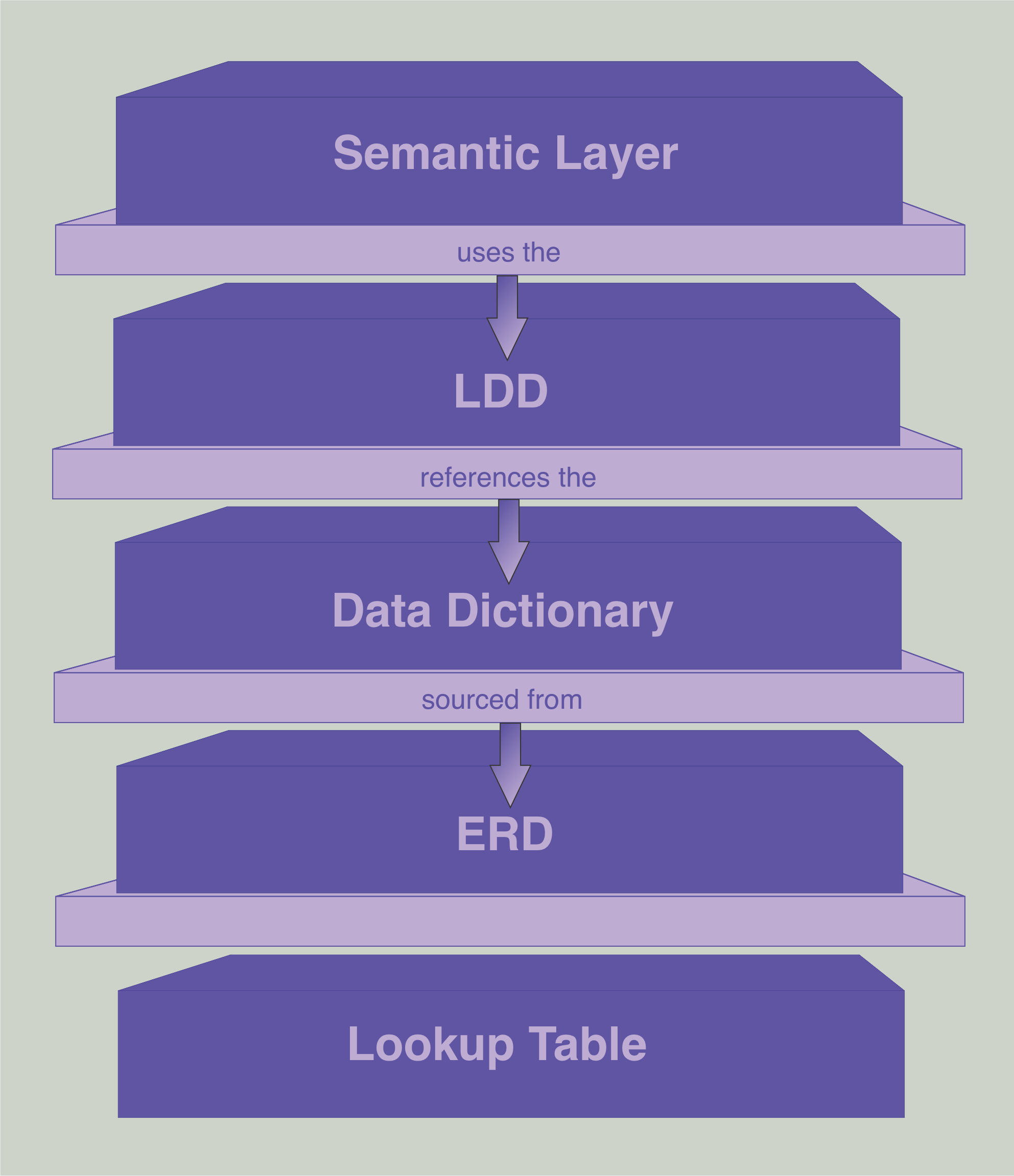
1. Semantics Layer: The "Business Why"
Definition: A natural language manifest that anchors every metric to a specific Stakeholder Persona.
Constraint: Define inclusion/exclusion logic and business intent in plain text.
Outcome: Eliminates "Hallucination Risk" by providing the ground truth for AI agents to interpret data.
2. Logical Data Dictionary (LDD): The "Engine & Proof"
Definition: The authoritative source of truth for all mathematical calculations and Validation Logic.
Constraint: Must contain the Logic DNA™ Signature, the "Hardened Math," and the Validation Rules (the "proof" that the calculation is accurate).
Outcome: Achieve Tool-Agnostic Integrity with built-in veracity; the math is not only consistent across tools but carries its own "proof of accuracy" in real-time.
3. Logical ERD: The "Blueprint"
Definition: A conceptual architecture of entity relationships focused on logic, not physical storage limitations.
Constraint: Must explicitly define join paths and cardinality (e.g., 1:N) to prevent fan-out errors.
Outcome: Extinguishes "Logic Drift"—preventing data integrity errors caused by improper joins.
4. Data Dictionary (DD): The "Map"
Definition: The high-fidelity physical source-to-target mapping.
Constraint: Maps every logical attribute in the LDD to its exact physical location in the database.
Outcome: Provides the Technical Provenance required for 2026-standard audits and system migrations.
5. Lookup Tables: The "Universal Translator"
Definition: Centralized reference data for all categorical labels and hierarchies.
Constraint: Must be decoupled from primary fact tables to allow for NLP-optimized labeling.
Outcome: Ensures a Unified Vocabulary for consistent, readable labels across all reporting interfaces.
Fluent in human.
There for AI.
What do you think?
Cast your vote today if you believe we need a simple, tool-agnostic way—like IfThenWhy™—to capture expertise from every persona (business partners, DBAs, auditors, and educators) so that knowledge is ready for both human collaboration today and AI integration tomorrow. Let’s not wait for the debate!